The man replies that he can only collect the ashes on Monday. And Dilman answers: “But Mondays always come very late in Paris.”
A quotation from Hiner Saleem’s latest novel My Ashes, Golda and the Others
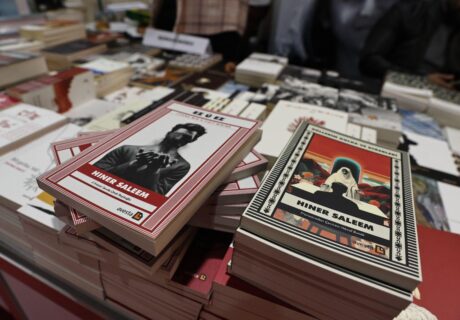
It’s been more than ten years since I’ve read My Father’s Rifle, written by the Kurdish author and director Hiner Saleem. The complicated emotions I’ve delved into are still so vivid; as if I’m experiencing these days.
I was fortunate to be among the early readers of his latest novel My Ashes, Golda, and the Others. As I finished the book, my heart was shattered by the stories I had become a part of, yet I felt myself carried away, drifting like ashes in the wind.
In My Ashes, Golda, and the Others, our protagonist, Dilman decides to end his life and leaves a will for his body to be cremated and his ashes to be taken to his mother’s grave in the city of Akre in Kurdistan. The adventure begins as Dilman packs his own ashes in a pickle jar and searches for someone to fulfill his last wish. Someone who can understand his will, someone who won’t blame him for his suicide, and someone who will not spit on his Muslim identity just because he cremated his body.
I find myself thinking that sorrow is a burden hanging on our backs. It is universal as well—present in every language and every culture. It needs no elaborate explanation; it simply exists, raw and unmistakable, deep within us—in our palms, our eyes, and at the tips of our toes. This pain doesn’t require fancy words to be understood; you just feel it so badly. Throughout my reading journey, I was immersed in sorrow. What I was reading were the disappointed stories of the Kurds who live a little far from where I live as a Kurd. Although I’ve never been in exile and have never been forced to migrate to another country, I found myself deeply connected to Hiner’s journey. Being an immigrant—without a country—stands in a place beyond my imagination. However, the dream of building a homeland with one’s own hands, only to watch it remain unfulfilled, is painfully familiar. Still, I was able to be a part of Hiner’s exile.
Dilman, whose ashes are cremated just as the workweek ends on Friday, asks the crematorium worker if he will turn off the furnace. The man replies that he can only collect the ashes on Monday. And Dilman answers: “But Mondays always come very late in Paris.” Though I have never been in exile, I felt the ache of those words, as if a blow had struck both my head and my heart.
In both of Hiner’s novels, the skeleton is built upon the ancient sorrow and disappointment of the Kurds, infused with subtle humor. In My Father’s Rifle, you first encounter a naughty joy; hope is intertwined with it. The joyful tastes in Hiner’s narrative envelop the spirit of his stories. Even though My Ashes, Golda, and the Others begins in hopelessness, the humor still resonates. From his witty remarks about his mother’s excessive religiosity to his friend Miso’s home in Italy—jokingly called ‘the White House’—Hiner weaves humor into the despair of his characters’ experiences. Even the electricity cuts, caused by the Syrian President’s brothers’ visits to their mistresses, become a source of dark comedy.
Throughout the book, Dilman carries the jar filled with his own ashes, and through it, he recounts the events that followed his forced departure from Kurdistan, all with a sharp and witty tone. Yet, the jar holds more than just ashes—it holds the remnants of our hopes that were forced to be buried in history’s forgotten corners. What’s inside the jar is the relief our people have been kept away from for many years. The jar contains the pomegranates from our cherished garden, the last touch of a mother’s hand and the final glimpse into the depth of her heart. Now, I see those ashes as the embodiment of all cultures that could not find a place to call home. As I immersed myself in these stories, I realized how masterfully Hiner conveys emotions that are universally human.
The tales inside the jar are overwhelming, and I’m fully aware of this. But once the jar falls to the floor, the ashes disappear into eternal emptiness. We, too, flow away with each speck of dust.
And so, I leave a few words for Dilman as well. While we struggle to open the jar’s lid to free all our belongings, you must stand with us. Long live, Dilman!